Yes, as they should. Just as fingersticks also show up. If you look you should see that each entry is tagged with the data source, so you can choose which to use. I’ve seen this with NightScout reporter; it allows the data source to be chosen when generating the reports.
1 Like
What are her preferences?
It’s not clear to me with the G6 whether the battery is “always on”, so draining continuously. The G7 is switched on by the inserter, so it should be the shelf life that matters, but it’s not clear if the “switch” is electrical or electronic, so there may be an “always on” issue there too.
In both cases the cell is lithium based but it seems the actual cell is different. In both cases the cell seems to be a straight lithium/manganese/oxygen coin cell which should have a shelf-life of 5 years or more.
The G6 uses a Maxell CR1632 in this teardown.
This teardown suggests the G7 uses a CR1216.
Elsewhere Dexcom asserts that both are lithium/manganese/oxygen cells, hence my previous assertion. The shelf life (no draw) on these are the same for the G6 and G7.
In use the G6 and G7 both seem to show about the same voltages, based on my experience with both and the numbers from the transmitter. At present my 8-day old transmitter is showing a no-load voltage of 2.88V and a load voltage of 2.66V. The nominal voltage is 3V, but the actual voltage in use is around 2.9V; according to one data sheet the voltage goes up initially!
So the answer to your question really depends on how much draw there is before the transmitter is first activated. From everything I’ve seen the G6 is “always on”, the transmitter does not have an “on” switch, so the G6 will have a limited shelf life because of that. The G7 clearly has an “on” switch but I don’t know how effective it is.
EDIT: update for the capacity, only relevant after the sensor is activated:
G6, 1632, 120mAh, 90 day run time, 1.3mAh/day
G7, 1216, 25mAh, 10.5 day run time, 2.4mAh/day
So the G7 comes out way ahead if used promptly.
Practical run-time life of the G7 is at least 1 month; I can get more precise figures but it seems to me that my big bag of used G7’s has maybe 5 happily transmitting.
3 Likes
Freestyle Libre. Or Eversence 365
1 Like
@ClaudnDaye The list is at Compatible CGM - LoopDocs . I was on an LnL open mic session last week and Joanne Milo (SoCal Loopers, now LnL) said she’s in the midst of testing the Eversense 365 with a test version of Loop (its been being worked on for both Loop and Trio for a while). There are still a few bugs to be worked out. From comments made by others, apparently Eversense is supportive of the effort. The scary part, if I heard correctly, was Joanne indicated a cost of $5k for the device, installed (it’s a short office procedure for subcutaneous insertion done with lidocaine). Joanne said it was pretty painless. The cost factor seemed high to me, but perhaps not if you figure the cost of Dexcom. CGM’s 10-days at a wack, total cost x (365/10), adds up! That’s with no insurance coverage, so if your insurance coverage kicks in it should be less. And if markets increase for Eversense and prices get dropped due to volume, it could come in below that figure.
4 Likes
I asked EverSense for the Medicare negotiated price (Part B) but the rep hasn’t got back to me yet.
Edwards bill Medicare $1050 for a three month supply of G7 sensors so that’s $4200/year but the Medicare negotiated price is $3215.04. Is anyone on Part B using EverSense? If so you can see the cost from your “Medicare Summary Notice”; there will be, most likely, 2 or 3 entries for EverSense in the claims list, one for the sensor, one for the doc doing the implant, one for the “link” (EverSense requires a skin attacked link, like RileyLink). There might also be hospital fees for the treatment room. The relevant figure is not the “Amount Supplier Charged” but the “Medicare-Approved Amount”.
There is a different negotiated figure for EverSense; all the other CGM sensors cost the same (the Medicare code is apparently A4239-KXCG) but that code is for a “non-implanted” CGM.
The actual Medicare cost of any CGM is somewhat higher because of the requirement to see a doc every 6 months; the doc bills additionally for CGM coverage. Given that the implant procedure could easily run to $1,000 the base cost seems to be comparable with all the other CGMs, though the only way to be sure is to know the Medicare negotiated prices.
3 Likes
For those of you who switched from G6 (and BIQ - not interested in CIQ. I don’t allow myself to get above 160, so the automatic 60% correction bolus is of no value to me)) to the G7: 1) is there a temp basal function. If I recall correctly, the temp basal function was there with the G7/CIQ system. 2) can I set my own target? From what I understan d the hard target is 110 bg. I like a pump target (where I want to be after a bolus - meal/correction - has done it’s job. Thanks
1 Like
It sounds like your questions might be more about comparing Tandem’s BIQ (Basal IQ) to CIQ (Control IQ), am I understanding correctly? If so, I outlined some of the differences here: Out of step Basal IQ - #2 by RachelMaraii
For CIQ, you can technically use the temp basal function – but CIQ will still intervene if it sees your trends going up or down.
1 Like
The Libre 3 seems like a drop in replacement for either of the Dexcoms and does claim a better accuracy (MARD) than either of the Dexcoms. EverSense claims a MARD that is worse than the G7 but better than the G6. This is all from the manufacturer published figures.
One issue is that the MARD figures vary with age group; LIbre 3 claims better for 18+, Dexcom better for paediatrics. Another is that MARD varies with BG range; below 100mg/dL I’ve got really terrible accuracy for the G6 and G7; worse than +/-20mg/dL, whereas in the 100-140 range I think the G7 manages +/-15% after a couple of days.
That highlights another issue with MARD; I don’t care what the Mean (arithmetic average) is, I care about the extremes because those are what causes the largest erroneous BG corrections with AAPS or any AIDS.
It’s another case of YDMMV; if the CGM doesn’t read well for me, at my age, in the BG range I maintain it really doesn’t matter what the MARD is. For example the EverSense 365 showed a MARD of 9% in the 70-180mg/dL range but better either side of that. It failed the old +/-20% requirement for fingersticks (95% within 20%) over that range too; it only managed 91%.
Here is a thread which includes some discussion the EverSense, @John58 reported (Nov 2024) trying the 90 sensor (EverSense 2?). Senseonics is the manufacturer.
1 Like
Actually was 2019 when I tried the original Eversense 90 day sensor. Back in 2019 they had a discounted cash pay offer for those who wanted to give it a try. That program is long gone. I still have two raisin shaped scars, one in each arm, memorializing the Eversense sensor locations.
My trial was overall positive as far as accuracy and reliability. The number one feature that I liked about Eversense (alerts without using an iphone, vibratory on arm) is now similar on G7 “direct to watch”.
I had one sensor that became infected which was a PITA. That sensor was eventually replaced. That experience of dealing with the infection was enough to turn me off from continuing with Eversense. I would expect the scarring issue might be a turn off for some users.
2 Likes
Thank you. I was hoping for having the temp function added back in and…having the lower target that I can set. At least I have enough G6 supplies to last for at least 6 more months.
1 Like
I have only used C-IQ now +, As to basal rates, at least 4 can be built, maybe more. I have regular and Pre Op. Pre Op is set at 75% of regular. That is basal, correction factor and u:carb.
When C-IQ is operative the basal rate can drop to zero if BG is <70, it can rise above the set basal rate if BG is elevated but not enough for a correction bolus. You can see this around midnight, basal went to 0 twice, BG trended up and basal was above the set rate.

I have been on prednisone and currently dealing with stress. Tandem does not recommend what I do, but I do what works for me. I will put in more grams of carbs than I am going to eat. Depending upon my BG I will do an extended bolus of 4 hours 50% now or up to 65% now.
This screenshot has the option of reducing Bolus calculation or not. If BG was higher that 110mg/dl it would be to increase bolus.

This one is the reduced bolus
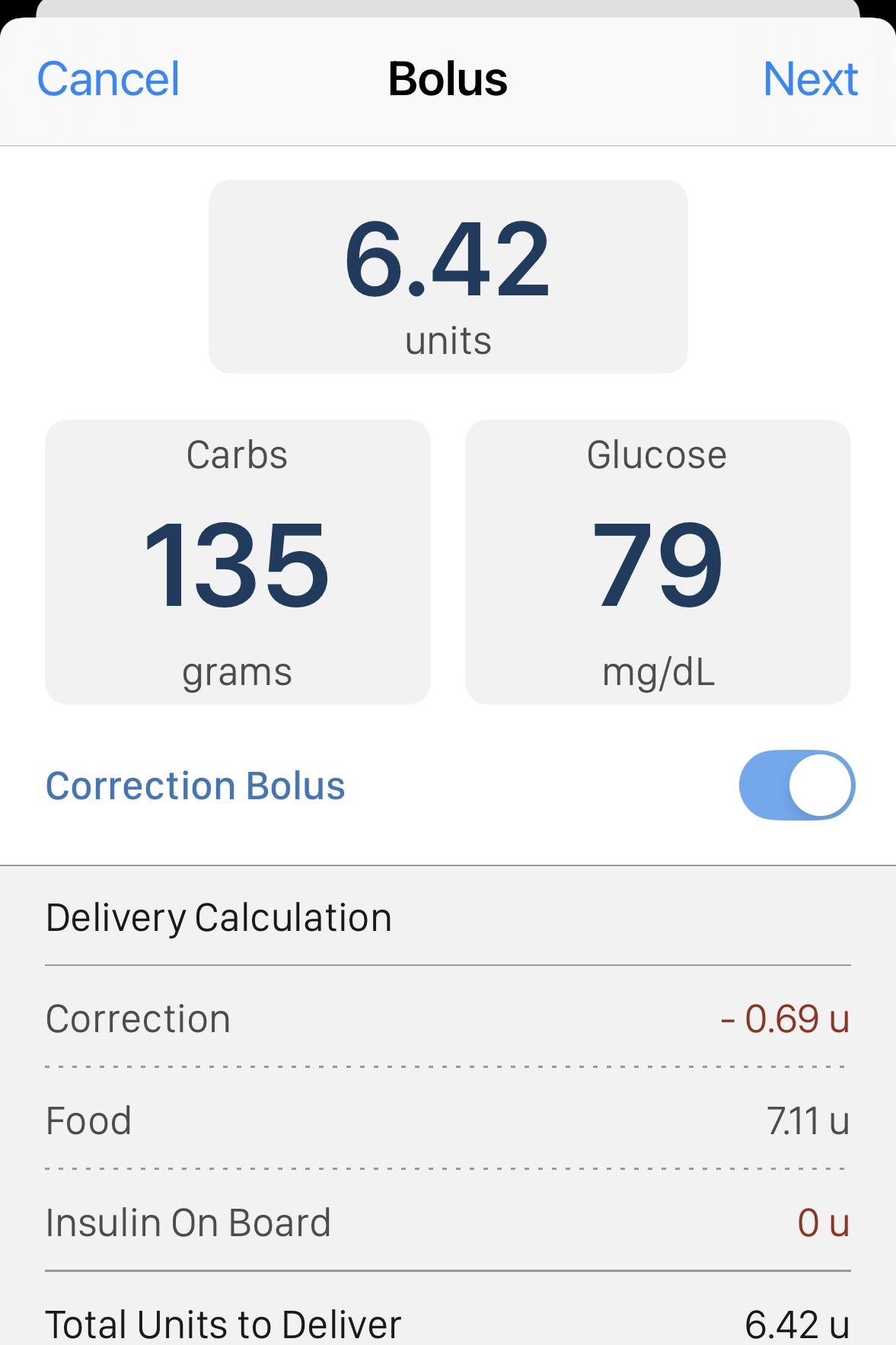
This one is No reduction.

The extended bolus up to 8 hours can only be done on the pump. The phone app only allows doing a bolus.
Now that 6.42u and 8u bolus can be manually changed. With my current situation I may do a manual correction 2 hours after eating. Yes this is also not recommended - insulin stacking. Well I do what I must do.
BTW even with hormone and stress induced insulin resistance my HbA1c last week was 5,6%. My endo is happy I am not because I often rise above 200mg/dl.
I hope that I understood your concern about C-IQ and this was helpful.
1 Like
Thanks.with my current setup (G6/BIQ) I have 9 different “time zones” in my pump, each with its own delivery settings.
One change to the BIQ system that I am unhappy about is running reports. I used to do two versions: 1) the “accepted” definition of “in-range” of 70-1`80. And 2) a report showing my preferred range of 60-140. The second report was for my review and analysis.
1 Like
Hmm, I think you should still be able to do two different report settings. Here is a screenshot of what I see on the “Reports” page of Tandem Source. I can toggle between the Target Range of 70-180 or my preferred range of 70-140, or a different Custom range.

I run Contol IQ sleep mode(target 112-120)for 24 hours. It provides both low side and high side protection.
I had a lot of your concerns, but in reality it had absolutely no impact on my A1C (still in the 5’s).
2 Likes
I understood MARD to be the mean difference from a known samples (lots of them), with varying conditions using laboratory gear, but didn’t think actual people (varying age groups) were involved. Apparently, actual test subjects (people) are involved and do frequent finger sticks tested by lab equipment verified by known samples. Learn something new every day!
1 Like
You can still do this too! I did a quick test, and you can have at least up to 12 different basal/correction/carb settings throughout the day. The “Personal Profiles” is still the exact same as BIQ, just that CIQ sets the Target BG and Duration of Insulin for you. I have 6 different Profiles set up as well (to compare how my current settings changed from previous).
As jim26 mentioned, you can run CIQ in “Sleep” mode indefinitely, and that makes it behave like BIQ, if you decide you liked BIQ better after all!
First thanks for verifying the ability to up to 12 profiles in C-IQ. My Tandem trainer called those who use sleep mode 24/7/365 sleepers, or sleep walkers. 
3 Likes
Thanks for the info. CIQ isn’t sounding as bad as I thought at first - except for the “
hard target” of 110. That’s too high. As background, I was born with poor kidney function, at stage 2 kidney disease when Dx’d with rapid onset T1D at age 30. Having the low target has kept me off dialysis, and slowed the [progression of the kidney disease during my 45 years with T1D. Since I can choose to use CIQ overnight - to prevent hypos, and go back to manual during the day, I should be able to adjust when the time comes.
Thanks to everyone fpr their info.
3 Likes
That makes a lot of sense. Hopefully they’ll allow a custom Target BG soon. My diabetes educator says Tandem has been working on it – maybe as soon as 2026! 
3 Likes