Doctor asks for help

I have a doctor asking for help. I told him that I would ask for comment from our community of ‘expert obsessives.’ (I forget which one of you came up with that terminology, but I love it.) Where are our diabetic pharmacists?

He writes this….

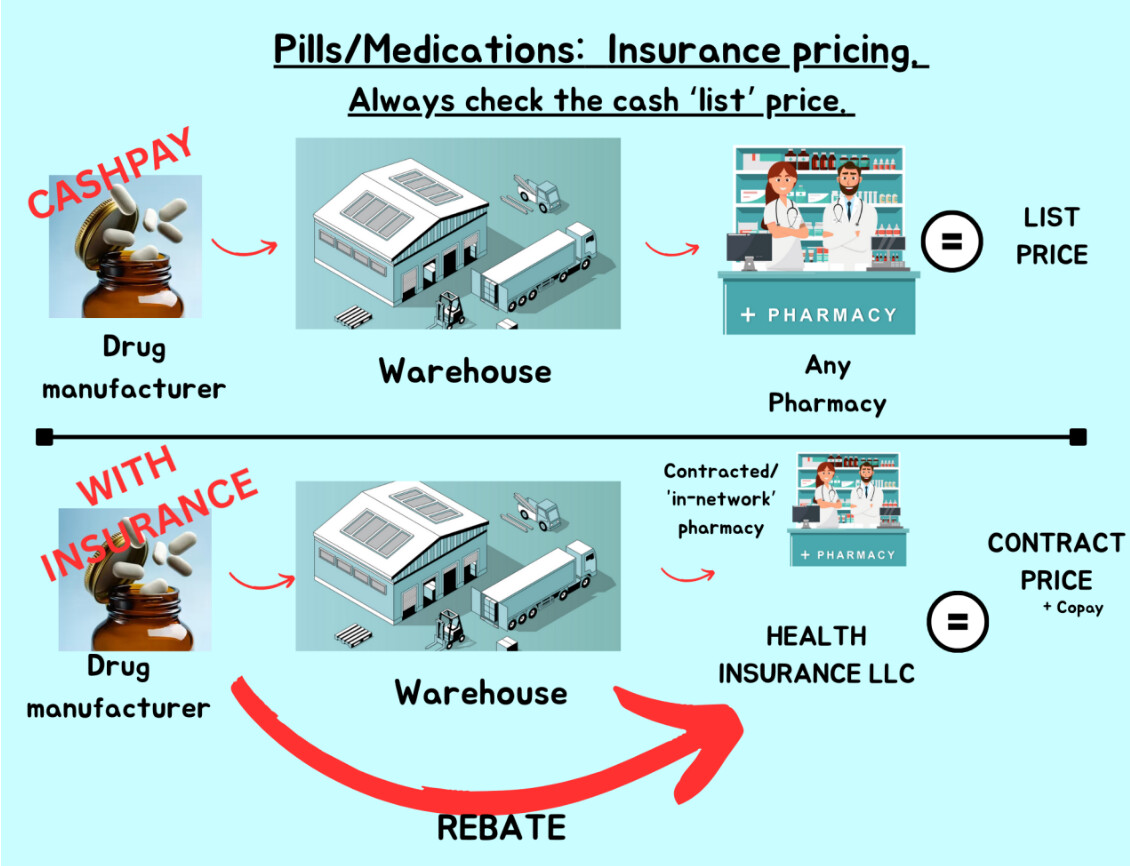
“Heather - attached a prototype version of an infographic I am doing to educate people on the smokescreen of having insurance for meds. Insulin - injectable ( not devices) is the poster child for this because even as it became generic, people with insurance were still railroaded into buying the branded.. Any thoughts or comments or documents on this - how insurance pharmacy " benefits" really may not be, in all cases, the best option. ?“

2 Likes

My first reaction is that this is an advertisement for Amazon Pharmacy. I am not upset by that, but it steps on the toes of so many other potential entrants: GoodRx, Cuban Cost Plus, and likely others. My second observation is that this is a simplistic view of the process. Of course, you should check the cash price, as it is sometimes lower. But, (and this is a huge) it is also spending outside one’s detectable, which may have implications at other times in the year.

So you purchase one medication every 30 or 90 days, sure, this example works. But let’s say you are in June and suddenly have a medication that is not less for cash price, or maybe is slightly more, but you know you will have to buy it several times. In that case, it is likely better to pay the higher price, since if you take the cash price, you will have to pay it repeatedly.

One factor that negates what I just said is whether your plan will reimburse you for cash claims you file. In most health plans, this is still an option, but the reimbursement doesn’t apply to the deductible, and of course, you have to collect receipts and process them for approval. Truly a hassle.

My point is that if the idea is to get ahead, it is next to impossible unless you are on limited medications and only buy them sporadically.

Which leads me back to my original point. There is no simple explanation for all users, and I have not even begun discussing Medicare, Medicaid, and TriCare.

I suggest that any such infographic is a fool’s errand. Best to stay out of the middle of it, as each individual is so different. But if there is universal advice, it is to learn your plan, talk to your pharmacist, and understand that circumstances change based on the time of year and future purchases.

5 Likes

I use insurance, and with the exception of the dexcom sensors get generic products. I recently called to get batch number information regarding a recall, and they were reluctant to give me details (quite defensive, actually, and lied to me about two of the products).

The graphic above suggests that with insurance, the drugs come directly from the manufacturer, which is decidedly not true in most cases. The logistical cost of that, the manufacturer shipping to each customer individually, would be extreme.

2 Likes

Did you all know that the doctors have virtually no info into plan details like if our plan supplies a sensor via DME distributor or a pharmacy? That sure explains a lot of failures out of primary care. I guess its mostly just a trial and error experiment for them about who fills the script.

1 Like

The doctor doesn’t know and doesn’t care. Mine provides a prescription to my employer’s script service; I receive the sensors in the mail (generally fedex).

Does it matter who fills the sensor for the prescription?

My replacements come directly from Dexcom; an expensive proposition as each one is fedex’d individually to me…and virtally all sensors have required replacement, some multiple times (replacement fails, replacement for the replacement fails, etc)…for a manufacturer to keep doing that is incredibly laborious and time-consuming, direct to each specific customer, given the large numbers of sensors that are produced and sold.

My normal source of sensors is through a warehouse, sent by the virtual pharmacy…they’ll also work through a local pharmacy, but that pharmacy is simply getting their products shipped from whichever supplier is available.

When I was using the Libre 3 sensors, I had to travel between multiple phamacies, in multiple states, to get enough sensors to use; one here, one there, and calling around I’d learn that so-and-so had one sensor, they’d hold it until I could get there, etc. I haven’t had to do that with the G7, largely because I get 9 shipped to me at a time as a 3-month supply, then begin getting them individually directly from the manufacturer as each fails.

2 Likes

I don’t think so. My understanding is that the rebate has to go via a third party to be legal.

If the rebate goes directly to the insurance company it’s just a negotiated price and then that is the price the patient pays.

If the rebate goes via a third party then the patient pays the price before the rebate yet the insurance company can still get a kick-back (not the full rebate in practice) from the third party.

In practice the third party is an organisation set up to pool the very limited power of multiple small insurers when negotiating with the big guys; the pharmacies and the manufacturers but mainly the pharmacies since they are the biggest (there are fewer major pharmacies than there are major drug manufacturers). As the health insurance industry consolidates the third parties are likely to get eliminated but I don’t think that has happened yet.

A side effect is the Medicare price; Medicare cannot negotiate (this may change), so Medicare pays the “retail” price. At one time the retail price was the price insurance paid but without the rebate. From what I’ve read of the Medicare rules it seems that might have changed; there seemed to be stuff in there about using prices post-rebate but maybe that only applies to the Part D insurers.

The small insurance companies do not seem to go for direct negotiation with the pharmacies; my pre-Medicare ACA insurance company, moda, did not tell me about any “in network” benefits. On the other hand I would expect HMOs to strictly use specific pharmacies; that’s the way HMOs work.

Now I’m on Medicare there seems to be a slight cost advantage is going to a “preferred” pharmacy (this is with Cigna this year). I’m moving to UNH next year so I don’t know if that will still be true. There does seem to be an advantage, though still not a major deal, going to mail-order supplies. I’m going to suck-it-and-see next year.

On the private side (i.e. buy-it-yourself) the big deal, the really big deal, is that the “contract price” (using the terminology from the powerpoint) is itself massively inflated for many things (famously for insulin) so this makes it unaffordable for regular human beings without insurance. People with insurance pay the “contract price” until they hit their deductible/copay/out-of-pocket-max/mole/whatever then pay much much less, if anything.

The thing here is that the “contract price” is massively inflated but only for some things. Lots of medications, while the price might be somewhat inflated, aren’t that inflated. Statins, metformin, etc. Others are, insulin (big mistake there), GLP-1 agonists, things that very few patients need.

This means that the insurance company can swallow the price inflation because most of their customers don’t need the things with the inflated prices. But who inflates it? Who profits? Follow the money; the pharmacies because they are the big guys, they negotiate prices directly with the manufacturer.

The interpolation of “warehouse” in the powerpoint is also somewhat weird. What is this “warehouse”. Mostly distribution is controlled by the manufacturer but for the major pharmacies they are the warehouse, the distributor. Indeed companies like Walmart are just as much distributors as retailers. I referred to “third parties” above, but they aren’t involved in distribution; they are negotiators who can get a deal; so far as I can tell they don’t do anything else.
The pharmacies seem to have direct access to an electronic database provided by each insurer. That’s a pretty expensive setup given the number of insurers but even the “independent” pharmacies pretty much have to have that so far as I can see. I assume there is some kind of expensive data provider for the small guys.

The docs have enough trouble dealing with insurance requirements for stuff like pre-authorisation.

Now… an answer to that would be a centralised database of treatment vs plan coverage. Nothing to do with prescriptions per se; it applies to things like the MRIs recently discussed in another thread. The first thing every US doc has to have is a medical billing specialist; without that you are just Rambo without a flame thrower. Medical billing specialists, like flame throwers, are expensive; IMO they should get paid more than the docs because keeping up is so much work!

1 Like

UHG owns the only pipeline for that data, as far as I know. That’s why the Change Healthcare attack was so dangerous. https://www.youtube.com/watch?v=be4vrnUu9J4

1 Like