CalorieKing
2 Likes
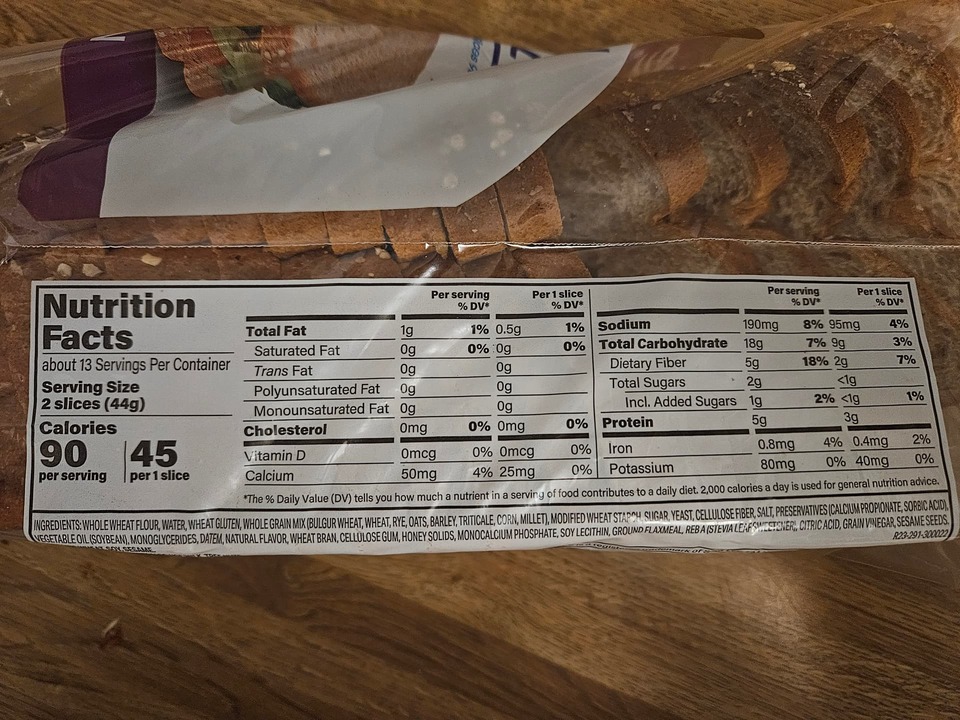
That is annoying…..like they don’t want to officially publish. Pic from my current loaf.
I’m going to guess it not much different than their normal bread, except slices are thinner(which I like).
5 Likes
I like the German bread, too, but can only get one brand here, Mestermacher. I will check this one out at Traders Joe. Carbs seem much lower than the German bread.
4 Likes
Thank you for the sourdough info.
We recently found this crisp bread, which is Norwegian Style and made in Brooklyn, called Knekkebrod. It’s available on Etsy. Everyone in our family loves it, including my T1D son. It does NOT spike him and is great for lunch, snack or an uncovered pre-sleep snack if he’s under 100 right before bed. It’s more like a cracker than bread, but it’s really satisfying.
8 Likes
I recently discovered a wonderful new brand of bread: BREAD ALONE. the company makes MANY different versions (including sourdoughs) which have not spiked my BGs AT ALL. They r delicious. My two favorites are Whole Grain Health Bread and their 9 Grain Health styles. they r delicious plain, toasted, with or without toppings ( butter, jam, PB, creamed cheese, etc) I keep them in their bags and store them in the freezer (they have NO PRESERVATIVES) and take out however many pieces i want, they defrost VERY quickly (or u could put them in the Microwave for about 15 seconds if ur in a hurry…lol) THEY’RE DELICIOUS!!! 
8 Likes
Is the knekebrod the same stuff that comes from IKEA?
1 Like
I got kicked out of there last week. I ordered some bread and then I put some peanut butter on it, and they started yelling at me.
“Hey, get out of here with your toppings! We don’t do that here. Read the sign, it says - ‘BREAD ALONE’!”

5 Likes
You’re hysterical!!! (BTW, I also eat it alone)
4 Likes
I am not personally familiar with the Ikea version, but from what I can see online, Knekkebrod is different. The IKEA brod looks like WASA rye crisp to me, which is a little bit like eating cardboard but fine. My son, who has T1D, does not like Wasa. Knekkebrod, on the other hand, is not as dry, is flatter/thinner, and has more seeds inside it. And it is just more delicious. And my son likes it!
2 Likes
@CatBirdDog I agree it’s like rye crisp, will have to look for what you mention locally.
1 Like
I have found that no matter what the bread, including sourdough or rye, the blood sugar goes up substantially. What varies is the time before it peaks. Some breads not as significantly, or a slower curve, but it still goes up. In Europe, some breads produce less rise and a more gradual curve, but nearly all breads, including good ones from dedicated bread bakeries, do it. Shame, as I love bread.
I have come to the conclusion that “net carbs” is absolute BS. The notion that one deducts fiber from carbs is neither scientifically backed, nor for anything but a marketing effort…every bit as much as “no sugar added” means squat. It’s about carbs, forget the fiber values. I haven’t found a bread that doesn’t do what I’d expect; cause a blood sugar rise. It’s just a matter of the steepness of the curve, and sometimes the duration.
4 Likes
I havent, as well, found a bread oproduct which does not cause my BG to rise, however i do not have the spikes that you are refering to, either early on or later. AS I’ve said before on an earlier post, Ive been eating this Bread Alone, which is filled with multigrain and is all natural (no preservatives, freshly baked and packaged and WILL go bad and moldy in only a few days if left out of the fridge). I stay relatively flat after eating it.
I have also found this to be true. I was buying no-sugar-added peanut butter for the longest time and recently the only PB on the grocery shelves had sugar in it. I bought it tried it, and Voila, no BG rise whatsoever. Go figure. (and I dont even bolus for the “said carbs” per 2 Tbs of 6gms in it)
3 Likes
While I appreciate the perspective on “no sugar added,” it does not mean “no sugar”, you still have to read the label to see the carb load the product has. Manufacturers have found the “no sugar added” label helps sales, not that they’ve actually changed the contents. It’s like claims of “low sodium”; check the contents as many “low sodium” products have more sodium than the non-“low sodium” products.
As to claims the science doesn’t exist to prove non soluble fiber carbs don’t count, show me the science that they do count. I’ve found dosing for them will drive me low, but that’s not “proof” either, just learning by experience.
Perhaps it’s just frustration talking (I’ve been there and will be again), but I tend to trust the scientific studies annd logic until disproved by other scientific reasoning and study (it sometimes does turn out there is more to the processes).
2 Likes
Given that one cannot prove a negative, there’s no proof that deducting fiber from carbs to magically come up with “net carbs” isn’t valid…but it’s a made-up term with no scientific basis. Fiber doesn’t alter the mass of carbohydrates in a given food sample. It may slow the consumption process and possibly alter the glycemic arc (which will vary with the individual, time, stress, hydration, combination with other foods, medication, etc)…but it does not in any way reduce the number of “carbs.” The term “net carbs” is a marketing gimmick, and a product claiming a “net carb” value does not actually have a carbohydrate value equivalent to “carbs minus fiber.” If the product has ten grams of carbs and five grams of fiber, it’s still got ten grams of carbs
Other than anecdotal “works for me,” the notion of “net carbs” has no scientific validation.
“No sugar added,” is marketing hype, and useless information. Whether sugar is added or simply natural to the product is irrelevant. What is important is the amount of sugar in the product, not how it got there. Much like what is important with carbohydrate value is the carbohydrate value, not a marketing value meant to reduce the imagined value by trickery.
Food labels are a combination of what’s required to be listed, what isn’t required to be listed, and marketing.
My wife thinks anything “keto” means diabetic-friendly. Far from it. In the marketing world, “zero sugar” apparently is secret code for “healthy” or “diabetic-friendly,” neither of which are true.
Anecdotally, I can relate that consistently I will see a blood sugar rise and reaction commensurate with the carb mass in grams for the food consumed…not for the food carb mass minus fiber. But then, that’s a scientifically valid observation, because the reaction to the carb count is the reaction to the carb count, regardless of any labeling effort to make it sound less by deducting the labeled fiber value.
3 Likes
I have T2DM for 35 years that has progressed over time to being managed by diet and exercise to diet, exercise, metformin and a pump.
On the whole net carb issue my anecdote is that I find that bolusing for net carbs + half the fiber. So if total carbs is 10g, net carbs is 8g, showing 2g. I would bolus for 9g. This works fairly well.
Another anecdote is that I had to use psyllium husks over the years and using the plain, unsweetened never had any effect on my BG, no spike, no decrease, nada.
We along with all animals are biochemical/electrical systems that has slight variations from one to another. For us with diabetes mellitus, regardless of type, these variations of the rest of the endocrine systems and other functions make our reactions unique to us.
By that I mean, what affects me is not necessarily going to affect others in the same way. Worse foods that did not affect our BG earlier, may later be a problem latter in life. For me this was corn (maize) products. I could eat a moderate amount of these foods without issue. That is no longer the case.
3 Likes
This has been a fun exchange. I’ve just read posts that say bolusing for (carbs - fiber) works for one person, bolusing for (carbs - half the fiber) works for another, and bolusing for all the carbs including fiber works for the third person.
The clear conclusion is YDMV, and we each need to find out through experience what works in our body. I don’t see any point to arguing about which of the three approaches is the right one. To do so would be like arguing about which religion is the true one. All the value is in the anecdote about which approach works for me, in case that gives someone else an idea for something to try.
6 Likes
Im so glad to hear this and now know that I am not alone. I have to bolus for both fats and for proteins. I MUST bolus for Greek yogurt for both the carb count as well as an additional 10gms per”serving size” so even if the lable reads “5gms of carbs, I must bolus as if there were 15 grams of carbs just to account for the high protein level in the Greek yogurt. It took me many tries to figure this out. I also bolus to cover proteins like eggs, fish, meat for 10gms per serving. Conversely, I dont need to bolus for foods (even with sugar and carbs in them) like peanut butter. Go figure. with foods like Salmon or dark meat chicken, I must do a dual bolus of 40/60 over an extended 2 hours just to remain flat. This was just a matter of experimentation.
6 Likes
A Pharmacist once told me that diabetics often know best how much insulin works for them. My motto is do what works.
6 Likes
Of course one must do what works. No question there.
If I were to tells someone that there are ten grams of arsenic in a muffin, but don’t worry, nine grams of it won’t count, the concept of net arsenic might seem a bit silly. Whatever I use to deny, dismiss, or diminish the total grams of arsenic is at best hyperbole, and one would best plan for ten grams worth of poisoning. It doesn’t seem so big a deal if we example it as carbs, but a very big deal if we example it as something more sinister, and yet the concept remains.
We pick our poison.
1 Like
Probably why I have mostly given up on precise carb counting and basically use estimates of small, medium, large carb counting for bolusing.
5 Likes