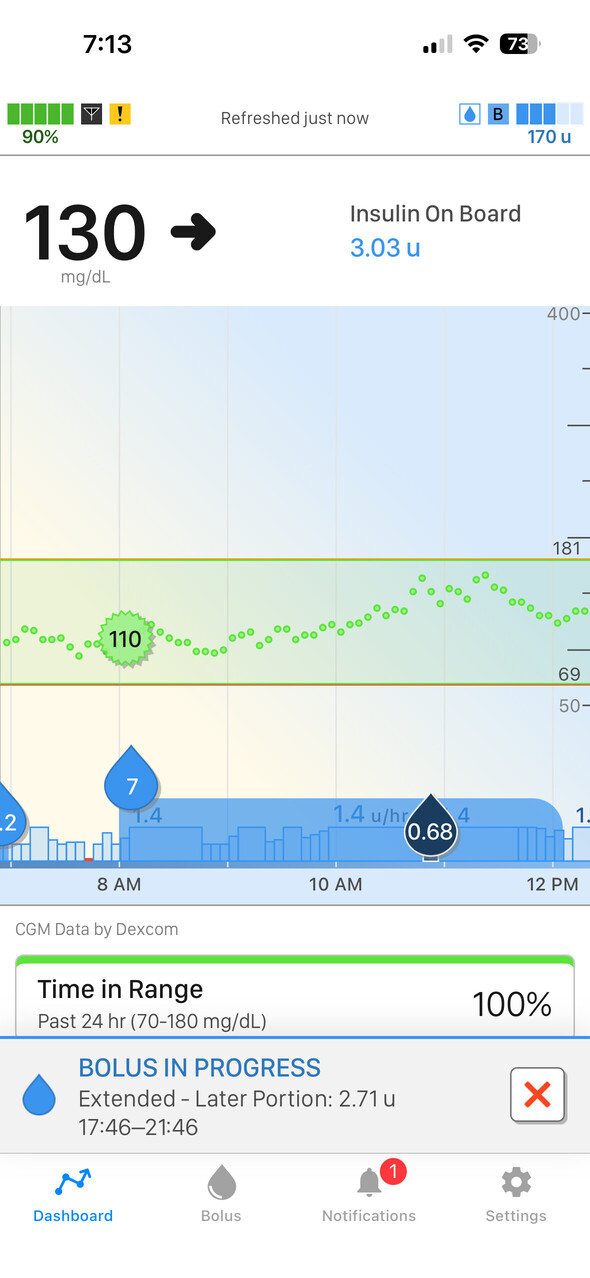
This is a screenshot from today showing a 4 hour extend bolus riding over basal. I used a a ratio of 4.3u now and 2.7u over 4 hours. The black drop is an automatic correction bolus.
1 Like
Exercise mode will also auto bolus a correction for a projected high, which I absoletly hate. It’s not smart enough to know you might of took fast acting carbs which throws off the algorithm based on what the CGM is showing and not knowing how the body reacts to carbs during exercise.
It might be OK along with an excercise ‘personal profile’, but a temp basil is easier.
I’d rather be in control of correcting my own highs while exercising.
4 Likes
I know your frustration, especially as an older person with tech experience, trying to get your diabetes technology to work. Since you are using an FDA approved system, unlike my DIY system, I would recommend calling Tandem repeatedly until you can find a customer service rep with the ability to sort out your software/hardware connections. Don’t give up when the first effort on the phone with Tandem doesn’t bear fruit. Just politely hang up and call back again!
A second Idealized ambition I have for diabetic seniors like us is try to enlist the help of younger people who have the right experience. There are many parents of young T1Ds who have given their all to figuring out the diabetes technology, driven by their parental love. Their children grow up and go away to college and naturally break away from parental support.
Some of these parents may want to use what they’ve learned and “pay it forward” to another diabetic. We, as a group should be able to make this happen. What do you say, young T1D parents who have graduated from primary support system for their child? Would you be interested in sorting out a tech hurdle that many elderly diabetics currently face?
1 Like
@CarlosLuis - I input this prompt to get AI help: how do i get tech help re tandem diabetes tech when the first call fails? It returned this. This isn’t always useful but maybe there’s some method listed here that might help you.
If your first attempt at getting Tandem diabetes tech help fails, you can try using the
live chat feature on the Tandem website, available Monday–Friday from 9 a.m. to 3 p.m. PT, or try the other support options listed on their Contact Us page. You should also always have a backup method of insulin delivery, as directed by your doctor and the user manual.
Alternative support options
Live Chat: For users in the United States, live chat is available on the Tandem website Monday through Friday, from 9 a.m. to 3 p.m. PT.
Contact Us page: The Tandem website’s Contact Us page provides other contact information and support resources.
Online troubleshooting: You can find troubleshooting guides on the Tandem support center for common issues with the t:slim mobile app and other products.
Important safety information
Backup plan: In the event of a pump malfunction, always have a backup method of insulin delivery, as recommended by your physician and the user manual.
Malfunction procedures: If your pump malfunctions, contact Tandem for a replacement pump and switch to your backup method of insulin delivery, notes MedTech Dive.
Field notices: For any current field notices or recalls, be sure to follow the specific instructions on the Tandem website, including any necessary software updates.
Know your pump: Be prepared to provide your pump’s serial number and other information when contacting support.
2 Likes
This is one of the only things I really dislike about Control-IQ! I wish that I could tell the pump how much and why I ate without giving insulin, and have it taken into account in the algorithm. Or at least notify me of an impending auto-bolus and give me five minutes to cancel it if desired.
When I’m really on a rollercoaster with Exercise mode on (like when I’m helping someone move and am exercising for hours), I sometimes will still disconnect my pump and give myself a micro-bolus so that the system registers “insulin on board” and won’t be able to auto-bolus for a while. 
4 Likes
I find exercise mode to be mostly useless. Whenever I am doing extended or rigorous exercise I turn off Control IQ and set a temp basal.
2 Likes
On long bike rides I just disconnect my pump / stop the insulin. That usually works best for me. When I do meal boluses on a long ride, I’ll do half of my usual bolus.
2 Likes
I am not sure if this is correct, but from what I have heard, I think exercise mode on Tandem and on Omnipod5 only change your BG target, right?
They do not adjust your insulin:carb ratio (I:C) or your correction factor (CF)?
Seems like a change in I:C or CF would make sense too! Like let the user setup their own exercise profile.
I know you can change your CF or I:C for different profiles. Why not have that type of adjustment incorporated into the exercise mode as well?
3 Likes
True for Omnipod 5, setting for Exercise Mode changes target BG to 150. I have used that setting on occasion about 1-2 hours before exercise if I have some insulin on board and am worried about dropping low from that IOB during exercise. All it does is pause insulin as soon as BG is trending towards below BG 150. The other approach, Auto mode during exercise does the same thing when the trend is towards dropping below BG 110.
So for me, if I have some remnant insulin on board from a meal or correction, normal Auto mode sometimes won’t react quickly enough and I end up too low during the workout. Those occurrences are when Exercise mode, started well before the exercise, seems to do better.
2 Likes
You could create another personal profile for exercise and change those two items. You would then switch your profile and turn on exercise mode.
3 Likes
@Eric While the comment is true if using “stock” Loop, with the code available just about anything is changeable, depending on your knowledge of programming and know the place (all the places) where it might need to be changed. I know @Eric knows this, just commenting for all those who don’t “know” it.
2 Likes
Hi @TomH,
Yes, indeed! Thanks for the clarification for others.
My comment was aimed at the fact that it used to be changeable within the app. You could open settings and adjust it so easily. On the fly you could change your duration or change it back, all depending on the situation. It was nice flexibility.
And the Loop developers trusted that you knew what your doing. You were responsible for it.
Now if you want to change it, you have to edit code and rebuild/reinstall. Certainly not something you can do when you are out playing tennis!
I was not happy that they removed it, because it seemed to be going the opposite way. I was actually very surprised that they removed it, and moving more towards the one-size-fits-all approach instead of allowing it to be easily customizable.
3 Likes
@Eric You’re right, it used to be a much easier fix…certainly not something to be changed on the fly, whether for tennis or whatever! In Trio (what I’m using now) it is still changeable, but the default is 10 hrs, much longer (stated to be because of the long tail of most insulins). I think the Trio setting is too long for most people, but default settings are built for safety of users, vice aggressiveness. For those contemplating a DIY AID system like Loop or Trio, the two programs have significantly different algorithm’s as their basis, you should not adjust them willy-nilly, but with knowledge of the impacts! There’s been talk of doing away with DIA in Trio as well, though I hope not; as @Eric says, the programs were built for people to be able to adjust settings for their needs. That said, the need for safety limits is understandable for those not familiar with what settings do what and the “rush for effect” without the knowledge to understand, particularly with children’s usage and remote dosing for them.
4 Likes
10 hours?!?!
Oh my gosh, what is that for, Lantus?!?!

Sorry, I don’t mean to be cynical. 10 hours just struck me as funny. I had no idea it was that long in Trio.
4 Likes
I thank both @Eric and @TomH for clarifying user access to the adjustable setting for insulin duration (DIA) in Loop and in Trio, DIY AIDS. In following user experience online in both the DIY systems as well as the commercial offerings, I read that many of the commercial system users adjusted the DIA setting (almost always lower then the actual physiological duration of insulin) as a way to make the system more aggressive in lowering hyperglycemia.
I understand that motivation and I am grateful that the system I use allows many adjustable settings to make its profile to more/less aggressive. I’ve found that leaving the DIA at 5 or 6 hours (when it was adjustable within the app) and then when Loop hard-wired the DIA setting for 6 hours, my ability to optimize glycemia was unimpaired.
I’m also surprised that Trio sets its default DIA to 10 hours! What that tells me is that the tail of action for the insulin formations is indeed low and long. It confirms to me that that long tail is not mathematically insignificant! But we all need to address the precision of “rounding errors” and the effect of DIA.
I’m not well-informed about how the algorithm actually performs. In my case, I’ve left that to the expertise of the developers. I am, however, relatively keen about how exogenous insulin actually acts given basal rates, bolus doses, and how ISF (CF) interact for my body.
At least for me, accepting the developer-chosen DIA works. When comparing how many controls commercial systems impose (target BG, at what BG hyperglycemia action is taken, the inability to “add” insulin like Afrezza), I feel unencumbered to shoot for the glycemia I desire.
4 Likes
@Eric Interestingly, I found this on the Trio Discord site today ref the 10 Hrs: “It’s because Trio/oref uses an exponential model instead of a linear model. More info here, and if you go to the BionicWookie link it goes into even more detail: Additionals - TrioDocs
I haven’t read the Bionic Wookie item as yet, but the exponential aspect may explain some of it. You’re probably more knowledgeable of it than I am.
2 Likes
Just piling on…I’m not a fan of that either. It should be like sleep mode which does no automatic boluses.
The kludge I use with Tandem’s exercise mode is giving myself a .05 bolus which locks out the auto bolus feature for a while (1 hour?) It’s really not ideal but I do find that exercise mode is pretty useful for mild to moderate exercise like walking or lifting weights or playing doubles in tennis. For more vigorous exercise, I suspend or use a temp rate. Nothing I do works perfectly, but some work pretty well.
4 Likes
Thanks @TomH.
Years ago, on mine I found the code that did the active insulin calculation and tweaked it a little bit.
There is a reference to the configurable exponential model (well, what used to be configurable  ).
).
This was one of the main driving factors for me to stick with the old version. The fact that I could adjust the duration in the app.
2 Likes
True also on AndroidAPS. “Exercise” means, to the algo, throw everything you’ve learnt so far out of the window because the monkey is about to start dancing.
For me exercise does not have the slightest effect on my I/C, C/I, B/G or any other ratio. Any slight changes take hours, and then only if I’m currently insulin sensitive (I think that means my liver is not able to keep up). The real change for me (YDMV) happens the next day; only then do all those ratios change, for the better IMNSHO.
1 Like
DIA with a linear model is a PoS; all the package inserts in the insulin we use say the same thing. @terry might care to chime in at this point because I certainly had an argument on TUD with someone who, IRC, was named Terry about the interpretation of those package inserts. Hum, not sure about the name; I had many arguments (username jbowler).
Uurgh, deleted several paragraphs of reference to great argument on TuD and FUD with people named Terry or Eric or, well, I don’t care.
The manufacturers of the stuff we inject produce data for various aspects of how it affects BG. Given the data a particular DIA is irrelevant and it’s not exponential, it is not linear. I might just accept a Poisson distribution shortly before I died under extreme torture. [Note: I just published that, you can’t patent it.]
But I can scan a package insert and derive insulin action from that. That is obvious to anyone who is not a complete fool; it’s printed on paper and provided to the patient patient. Only the impatient patient fails to read it, sort of.