But if you got a bad one, you’d never be sure if it was Dexcom’s fault or if something was mishandled or fishy as it made its way to you…
1 Like
@bostrav59 if you ever want a couple to try out, I’m localish to you, and have back-ups.
3 Likes
Thanks everyone for advice and offers. @Mariethm that is very nice of you. I think I will talk with my endo when I see him in a couple of weeks and will keep you posted.
4 Likes
I switched earlier this year, after much hesitation because of reading of so many bad experiences with G7. I love it, and have had very few problems. Two replaced since starting on it in March. Vouchers emailed within a couple days of filing my complaint form online. (I’m collecting the little magnets cause I’m sure they’ll be good for something.)
4 Likes
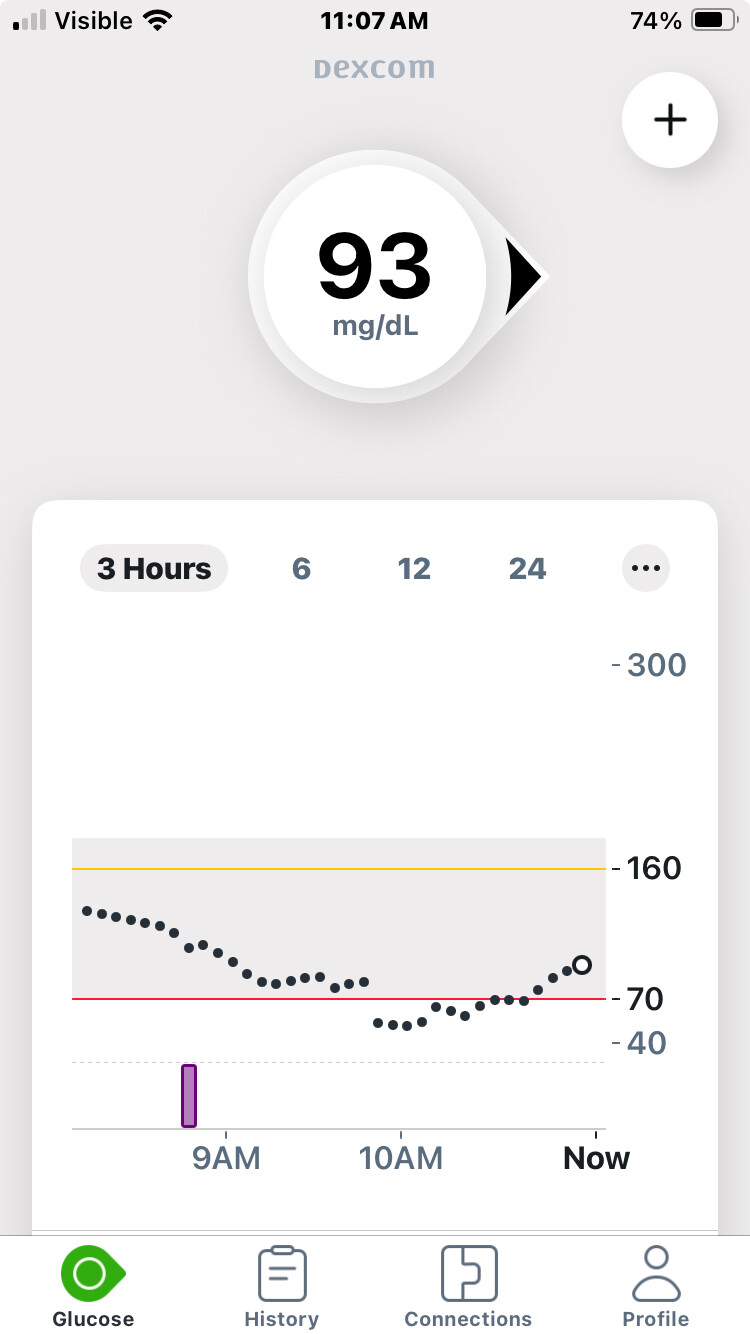
This is typical of the quirkiness of the G7. Supposedly I was flatlining at BG of about 80 and five minutes later I was flatlining at 53 ? I have no idea why the G7 does this but suspect the software needs to be repaired or improved. G6 never did things like this as far as I can remember.
2 Likes
Thanks John - unfortunately G6 does the same kinds of things.
I’ve noticed that my kids’ generation - under 30 - tends to accept the data from technology without much questioning. This doesn’t work with the G6.
There have been times, about once a month, usually shortly after inserting a new sensor, when the sensor reading will take a dive to the bottom of the blood glucose measurements (40) and just lie there, generating many alarms along the way.
It recovers after a couple of hours. But it’s pretty annoying when it is happening at 3.00 AM. And if you actually believe the readings, you will get yourself in trouble.
It doesn’t seem to do that on the high side - has anyone had the experience of it going crazy on the upside of BG readings?
e
8 Likes
I am too but I have a word of caution, don’t remove the magnet until you remove the sensor. If a sensor fails and you contact Dexcom for a replacement, they might ask for the inserter to be returned along with the sensor, and one possible failure mode might be the magnet was upside down (or missing).
2 Likes
Thanks for that information!
1 Like
Here’s my update after yesterday’s visit with my endo - who is Dr Giulio Romeo at Joslin Diabetes clinic.
He’s a wonderful endo as you might imagine he spends all his time with diabetics. When I asked him about switching from the G6 to the G7, he said:
“I believe I can offer you a definitive answer to that question at this time … do not switch”
This is highly unusual and definitive statement for Dr Romeo, who tends to talk in conditionals.
His rationale was quite different from what we have discussed, so I thought you would all be interested.
-
Dexcom’s G7 defective units are still in the supply chain. According to him, Dexcom announced that it had fixed its production problems only in July 2025. That isn’t that long ago for a supply chain - so on that basis he felt that it would at minimum be prudent to hold off for several months before switching - to get all the bad sensors out of the system.
He gave me a lot more detail about the production problems - that they were quite prevalent (as many as 40% of units shipped!) and that Dexcom did not want to recall - rather they were handling them on a case by case basis. -
The G7 transmitter isn’t nearly as good as the G6 transmitter. So if you find that sometimes your transmitter loses connection with your pump on the G6, that will only get worse (much worse) on the G7. He said that the G7 transmitter needs line-of-sight with the pump to work well.
From a design perspective, you’d expect this to be true given that the G6 transmitter is designed to last 90 days while the G7’s transmitter is disposable.
Dr Romeo and I discussed our view that the G7 was not a great product for DexCom customers. On the business side, the G7 problems have made it impossible for Dexcom to retire the G6, which they’d like to do.
For me, my hope is that I can hold on to the G6 until Dexcom comes out with the G8. But I doubt that will happen….
10 Likes
@bostrav59 With no intent of disbelief of your findings, I appreciate the comments from your doc, but they drive some other concerns and questions. I agree the G7 is not perfect…I personally dislike the “Wait 3 hours” screen…the audacity of the statement belies the actual time I’ve experienced, but my actual experience is disconnection is no worse G6 to G7 and other factors (warm up time is a definite plus, perceived accuracy need to be considered and have some value. That said, I also understand complaints from those that a have experienced not pairing and goose necking, and the frustrations experienced, particularly with a 30-day supply limitation due to insurance coverage (not a sensor or Dexcom issue). BTW, I watched the video of Dexcom’s COO…has anyone used the QR code replacement of such sensors? While I bow to the experience of a doc who lives to see CGM patients, I can’t help questioning an indicated 40% failure figure as that would drive any manufacturer out of business almost entirely (lies, damned lies, and statistics). That doesn’t mean I overly “trust” Dexcom, but also appreciate whether it is a design defect or a production defect, one is infinitely easier to diagnose and correct. But how much time is needed to remove a supply chain problem? If 6-8 months isn’t adequate, what is? This is a key question to resolving “when” to trust or “when” to switch? As a former inspector of organizations and functions, I have to question a claim “you’d expect this to be true” regarding the transmission isn’t accurate. While it may seem “logical”, it is not; it continues the common misperception that “size” or “length of time” matters (no innuendo is intended), which just is not true. It depends on the power source, transmission strength, battery materials/type, antenae design, frequency of transmission, and other factors. That said, it may or may not be accurate. My anecdotal perspective is that it’s no worse nor better…disconnection was/is experienced about the same amount G6 to G7 to make users question reliability, though still far better than the “prick your finger” method.
I don’t question @bostrav59’s experience or the doc’s. But we need to be wary of the conclusions drawn and whether supported by the data…even if it may seem logical and reasonable. And yet, we all yearn for improvements!
6 Likes
I think you’re right and I had some doubts putting that number in - I may have mis-remembered, so apologies for that - and good catch!
And overall, I really appreciate the discussion and your perspective. I can imagine the Dexcom engineers making some of the same arguments about the transmitter during product review meetings.
You’ve already made the switch. Knowing what you know now, would you do it again?
4 Likes
@bostrav59 I held out a while, (my Endo called it a toss up depending on personal preference!). But I’d place the G7 just slightly above the G6. I think the improvements in size (yes, it’s a topic despite my earlier comment), warm up time, tilt it. However, if just going on performance, I’d call it a draw or pretty close to it. If adhesives are an issue (they aren’t for me), that’s another consideration. For me, the additional adhesive “surround” is not needed either, it sticks fine (too much?) without it.
5 Likes
In order for Dexcom to be able to leave “defective units” on the market, they would have had to demonstrate to FDA that there is no (significant) risk to public health. Had they not been successful at that, FDA would have forced them to recall (or field correct) affected inventory.
If I remember correctly, in the March WL, FDA said that the same problems that existed with G7 also existed with G6, and that neither device received FDA approval for those specific design changes. Dexcom apparently went through all the required design control processes and testing for said changes, FDA just disagreed with Dexcom’s conclusions.
Apart from a rash of G7 failures I had a couple of years ago, which I think may have been at the time Dexcom first set up mfg in Malaysia, my overall experience with G7 is about the same as G6. The obvious improvements to G7 - size, low profile, reduced warm up time etc are all very welcome. But my experience is that performance is just about the same. I rarely have issues with device communication, but when I was on G6 I was not using a pump at that time. When I do it is resolved very quickly. The adhesive used on G7 is definitely superior to G6. I also no longer need to use the overpatches.
2 Likes
Well stated. The manufacturer errors were a result of trying to get too many out there too fast. The disagreement with theFDA withe regards to process changes did not impact distributed product. It’s a better product with some software hiccups, I look forward to the software updates coming with the 15 day.
Have not had trouble connecting to pods or iphone with G7.
I had some recurring problems with G7 sensor quality (sensors dying early or bent wire issue, seems like it was close to 40% failures for one batch of 9 sensors) up until a few months ago but lately have experienced no defects after using up the last of those lots. Included in that bad batch was one sensor that had terrible adhesive and fell off right through the overpatch.
Anecdotally it looks like sensor quality has improved lately. Time will tell!
1 Like
Besides the patch Dexcom supplies FREE, try a small a small Tagaderm patch (Amazon). Will not only cover it but water proofs it.
1 Like
I estimate the failure rate on my G7 sensors at about 90%, so far. I went through a couple a few days ago, both were replacements sent by Dexcom for others that failed, and the replacement for those failed this morning. I haven’t put another one on, presently. I’ve got rashes on both arms from the adhesive, one arm painfully so, and they itch and burn when in place. 20 days after one was removed in one spot, still discoloration and marks, and itches like crazy. I’m running out of places on my arm to put them. The last one, this morning, just fell off…arm felt like it was burning, woke me up, felt the sensor and it was coming off. The skin is still weeping, from the rash.
When they work, they seem to work, though do make unexpected changes, simply hold a reading for a time that isn’t accurate, or go low with low alarms, when the fingerstick glucometer shows normal. The problem has been a very high failure rate. Today’s failure worked for three days. They do seem to require frequent recalibration and the first twenty-four hours, the readings aren’t very accurate. Dexcom continually has replacements enroute, due to the frequent failures. I’ve run out of sensors because so many were failing so fast, replacements hadn’t arrived from Dexcom, and I do travel a lot with work, meaning I can’t always get the replacements.
2 Likes
The free patch that comes with the G7 doesn’t hold the same way Not Just a Patch does. I’ve been using NJAP for a year now and it really makes a big difference in keeping the sensor secure, especially since the G7 is smaller and easier to knock off. And yes, I’m super excited for the Apple Watch integration too!
2 Likes
The inflammation from the allergic reaction could be making the failure rate higher. I have a bad allergy to the adhesive too, in the G6 and G7, sometimes resulting in bruise-like discoloration and it would feel like my skin was on fire. My allergist determined I’m allergic to at least Balsam of Peru and colophony. My dermatologist prescribed a steroid cream to help with the existing rashes.
This is what has worked well for me – I haven’t gotten a rash in a long time now. I’m not sure if this will help your specific allergy, but anything is worth a shot to not be in pain!
- Before putting on a new sensor, spray/rub the area with a generic Flonase and allow to dry completely.
- Spray with Cavilon and allow to dry.
- Trim off the flaps on a Bandaid HydroSeal Large hydrocolloid bandage, so it’s just a large circle. Place on skin. (Bandaid is one of the only brands I found without my allergens, via messages to customer service.)
- Center the G7 inserter over the hydrocolloid bandage and insert. Mine always go through the bandage with no issue.
- Place a Skin Grip overpatch over the whole thing. The G7 size works great. (The hydrocolloid does not stay on by itself for more than a few days before it starts peeling off, so an overpatch is important.)
I’ve had good success using the G7 on my abdomen too, when I was out of spots because of rashes. Dexcom US only recommends using your arms – but Dexcom Canada says arms or abdomen. 
I’ve also started to try to calibrate as little as possible in the first 12 hours… I keep the old sensor on my phone during the “grace period” and connect the new sensor to my pump, so I can compare the graphs and have one with “good” data still. If I start calibrating after that point, I seem to get fewer “temporary sensor issue” notifications. But if they’re failing often, you won’t be able to try that until your skin hopefully feels better! 
5 Likes
Most of the failures occur on fresh skin, rather than over a reacted-area. They typically occur shortly after installation, though not always. In a number of cases, the probe wire is sticking out the back of the sensor, indicating it failed to penetrate the skin, and in other cases, it’s folded under the sensor between the skin and sensor, also having failed to penetrate the skin. Given that it fails to penetrate the skin so frequently, I’ve no faith of it penetrating an additional bandage or barrier.
This is the first time for me that one failed by falling off. Normally they’re very difficult to remove, with or without the overpatch; I quit using the overpatch because of the extreme discomfort, rash, and reaction or effect on skin under the overpatch. I’m trying different cremes and rubs on the rash or reacted areas presently, and am without a CGM until I can sort this out.
I have some “barrier wipes” coming that should be here today, and some underlayment patches that come precut with a hole for the sensor and that are trimmed to dovetail with the G7 applicator for alignment purposes, but those wont’ be here until the end of the month, and I’ll be overseas by then. If the barrier wipes don’t do it, then I’ll probably be sensorless for month or more; just finger sticks. If the reaction of skin damage issue continues, I’ll be CGM sensorless permanently. My left arm application site feels like rough leather, almost like the after effect of a partial-thickness burn.
3 Likes